How UNITE EcoPack Develops Hot Food Packaging for Delivery
A fried chicken meal can leave the kitchen crisp and arrive damp. A rice box can look secure on the packing counter but lose its shape after a journey in a crowded delivery bag. For restaurant groups and food-service distributors, these problems start with the relationship between the food, the container and the way an order travels.
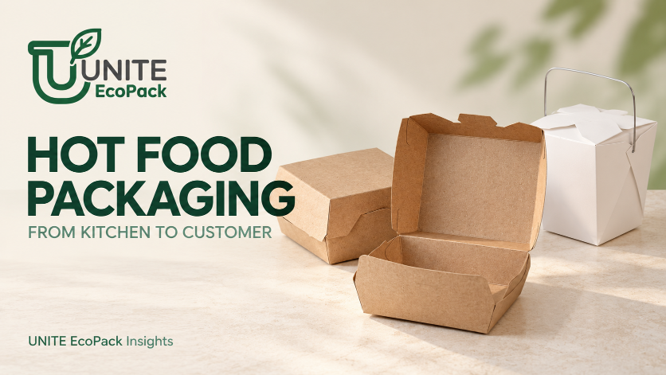
At UNITE EcoPack, we bring Malaysia-based manufacturing and Shanghai product-development support to paper and aluminum food packaging. Our range includes kraft and white takeaway containers, noodle containers, wire-handle boxes, paper food boats and aluminum foil containers. For a buyer choosing a hot food packaging supplier, that range provides different starting points. The final choice still needs to be tested against the actual meal and delivery process.
A useful development brief describes what customers should find when they open the order. This guide explains how to turn that expectation into decisions about moisture, barriers, closure and sample approval.
Start with the food at the end of the journey
A request for a hot-food box is incomplete without the menu. Fried items need attention to surface moisture. Rice and noodles may bring steam and sauce into contact with the base and folded corners. A burger has its own risks: a tall portion can press against the lid, while a loose fit allows the contents to move.
Record the normal portion, any sauce, the temperature at packing and the time between filling and customer opening. Include the wait for collection, not only the time on the road. Buyers should define these conditions with their operations team; a packaging specification cannot replace a validated food-handling process.
Then agree on observable acceptance criteria. For example, the lid should remain engaged, the base should support the filled portion, and the exterior should not show unacceptable staining. Assess the food too. A container that survives the journey is of limited value if the meal inside arrives in poor condition.
Balance steam release with heat retention
Closing a box around freshly cooked food traps warm, moist air. Condensation can affect a crisp coating or collect beneath the lid. Ventilation may help moisture escape, but it also changes heat retention and must suit the food, the delivery bag and the handling conditions. Adding holes without a trial is not a complete solution.
Detpak illustrates how these details can work together. Its current medium hot-food box lists ventilation holes, an anti-fog window and a lock-in closure for a food-warmer application. Those are features of a particular product, not proof that every paper box performs the same way. The useful lesson for a buyer is to ask which feature addresses which problem, and under what conditions.
For a UEP project, begin with the available container structure and discuss whether changes are required. A plain hinged kraft box should not be described as ventilated unless that feature is actually specified. Compare approved samples using the same food and journey, so changes in crispness or condensation can be judged fairly.
Match the barrier to grease and moisture
The outside appearance of a paper container does not identify its food-contact construction. Board, lining, folds and seams all influence how it behaves with a particular meal. An oily fried portion and a sauced noodle dish can therefore require different evaluation, even when their containers have similar dimensions.
BioPak describes its medium BioFlute hinged box as a corrugated format with a grease- and moisture-resistant coating. Its specification also identifies an aqueous lining. This makes the material system part of the product description rather than leaving buyers to infer performance from a brown paper finish.
UEP lists paper-and-PE construction for several takeaway categories. Buyers should confirm the selected SKU, lining and intended use before approving a program. Ask for documentation relevant to the destination market and exact article. Do not infer microwave suitability, compostability or an unlimited hot-fill range from the word paper. Grease resistance is also not the same as suitability for transporting free liquid.
Check closure and presentation together
A closure must work when staff are packing quickly and when the filled container sits beneath another order. Test the locking tab, hinge and corners with the real portion. Inspect whether the lid closes without compressing the meal and whether the pack stays stable inside the intended bag.
Vegware offers a microflute hinged window hot box positioned for hot cabinets and food to go. Its combination of a corrugated body and window lid connects container structure with visibility at the point of sale. It is a useful reminder that an attractive pack and a practical pack need to be assessed together.
For UEP buyers, a kraft clamshell can be a starting point for a hinged format, while a white wire-handle box offers a different shape and carrying arrangement. Neither should be selected by photograph alone. With a metal-handle design, any reheating claim requires explicit product instructions. Check the opening sequence as carefully as the closure; customers should be able to access the meal without an awkward handling step.
Test the complete delivery order
Packaging decisions continue after the individual box is closed. A hot meal may travel with a cold drink, a salad or a separate sauce cup. Bag layout, collection delays and the weight of other containers can change the result.
DoorDash merchant guidance recommends matching containers to the food, separating items that should not travel together and testing packaging in delivery conditions. This brings an operational perspective to the product examples above. The packaging team needs to understand how staff assemble the order and how the courier carries it.
Run a trial using the planned container, bag and order mix. Photograph the meal before dispatch and at opening. Record any movement, wet patches, tab release or visible deformation. Change one variable at a time where possible. If a trial fails, the next action may be a different fill level or packing sequence rather than a new material.
Turn sample findings into a production specification
Once a format works in the trial, record what was approved. Include the article reference, dimensions, material construction, portion limits used in testing, closure details and artwork version. A sample photograph alone is insufficient for repeat purchasing. Retain a physical approved sample and a written record of the conditions used.
UNITE EcoPack SDN BHD operates a manufacturing base in Johor, Malaysia, with design and product development in Shanghai. Our website reports a facility of approximately 40,000 square feet and monthly production capacity exceeding 20 million pieces. These are company-reported manufacturing figures across the business, not a promised output or delivery date for one customized SKU.
Our OEM service covers branding, color, dimensions and material choices, subject to the requirements of the project. The published workflow moves from inquiry and design to sample approval, production, quality control and shipment. For a hot-food program, the practical advantage is that the buyer can bring a menu-specific brief into that workflow and confirm the chosen specification before committing to production.
Ask us to confirm the applicable quantity, tooling requirements, lead time and supporting documents for your order. If a structure changes after the trial, repeat the relevant checks rather than assuming the earlier result carries over.
A practical sample evaluation sheet
Use the following fields to compare candidate containers. The buyer should set the acceptance limits before testing; the table is a planning tool, not a product performance claim.
| Check | Record | Approval question |
|---|---|---|
| Food and portion | Recipe, oil or sauce, fill weight and height | Meal fits without lid contact or excessive movement |
| Packing conditions | Food temperature at filling and wait for collection | Conditions match the approved operating process |
| Delivery journey | Duration, bag layout, order mix and stacking | Container stays stable in the planned order |
| Steam and barrier | Condensation, food texture, staining and wet corners | Food and exterior meet agreed appearance criteria |
| Closure and opening | Tab engagement, deformation and customer access | Closure holds and opening is practical |
| Approval record | SKU, construction, artwork and dated sample | Written specification matches the tested sample |
Discuss your delivery packaging brief with UNITE EcoPack
Send our team your menu, portion size, target market, expected journey and preferred packaging appearance. Include the main issue you want to address, such as condensation, staining, closure or portion fit. We can discuss an appropriate starting format and the customization needed for sampling.
An effective hot-food packaging program begins with a clear meal and a repeatable trial. By connecting product development with manufacturing, UNITE EcoPack helps buyers move from a container selected on appearance to a specification they can evaluate and reorder with confidence. Explore our product range or contact us to discuss your next food-service packaging project.